
definition
strict definition
cantilever bridge
A bridge whose spans project from anchoring piers instead of simply resting on supports at both ends.
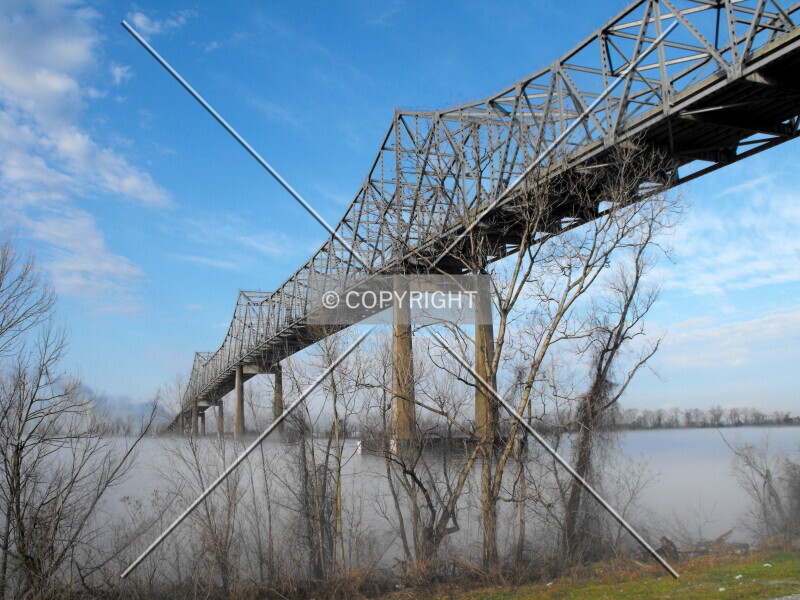
A cantilever bridge is a bridge whose span or spans are anchored by one or more piers, from which they extend horizontally. In many cases two cantilevered lengths can meet in the middle of a span. It is distinguished from the simpler beam bridge in that the span(s) cannot be said to rest simply on both ends, but must be held strongly enough to reach out across the space.
Each cantilever reaches outward from a support that holds it against rotation. Its projecting end can extend over the open crossing.
Opposed cantilevers can meet between their supports. This differs from a simple beam whose two ends rest directly on supports.
cantilever bridge Photos
Related definitions
-
arch bridge
A bridge whose deck is supported from below by one or more arches carrying loads toward their end supports. -
beam bridge
A bridge with a rigid spanning member resting on supports at both ends of each span. -
cable-stayed bridge
A bridge whose deck is supported by tense cables mounted on columns or in the surrounding landscape. -
float bridge
A bridge whose span floats on water and is simply anchored to stabilization points. -
movable bridge
A bridge of any form which is capable of controlled movement in order to lift or remove its span. -
suspension bridge
A bridge whose span hangs from main cables anchored at its ends, commonly supported above the span by towers. -
trestle
A bridge or viaduct whose deck is carried by a continuous rigid support framework, often over many small spans. -
truss bridge
A bridge whose span is carried by a connected truss framework with members acting in tension and compression.