
definition
strict definition
clearance
The free space allowed within a structure or pathway for entry and passage.
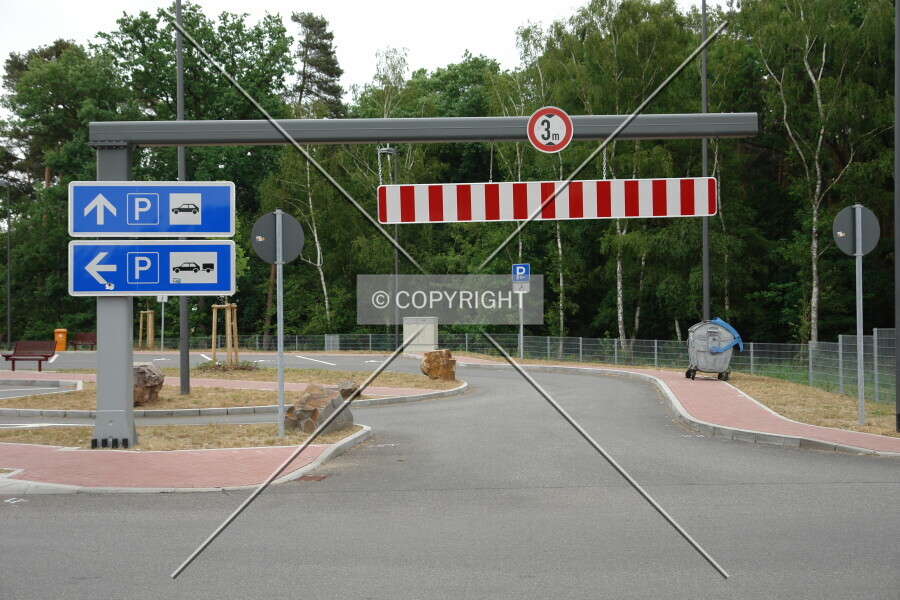
Clearance is the vertical, horizontal, or total spatial parameters allowed within a structure, pathway, or part of a structure for the passage of persons, vehicles, cargo, animals, etc. Any fixed protrusion into the framework to which a clearance is assigned may reduce the clearance dimensions.
The relevant space is the opening or route available for passage. A beam or another fixed projection can reduce that opening even when the surrounding structural frame is larger.
Height and width describe different limits on the same passage. A vehicle can satisfy the height limit while being too wide, so one clearance dimension does not establish all others.
clearance Photos

More specific definitions
2 sub-definitionsRelated definitions
-
angle
Measurements of geometric orientation, alignment, or opening expressed in degrees of arc. -
area
Measurements of bounded two-dimensional space, including cumulative areas across several levels. -
depth
Vertical distances below a structure's base level, measured between specified upper and lower points. -
duration
Measurements of elapsed or expected time between a defined beginning and a defined end. -
elevation
Vertical positions of objects or reference points measured above, below, or at mean sea level. -
energy
Measurements of energy handled by an object and the power at which it is produced or consumed. -
height
Vertical distances above a structure's base level, measured between specified lower and upper points. -
hill size
The size category of a ski jumping hill, measured from the take-off point to the end of the landing area. -
humidity
Measurements of moisture in air or other gases as an absolute quantity or a percentage of saturation. -
length
Measurements of horizontal, diagonal, or travel distances between two defined extreme points. -
mass
Measurements of material quantity, commonly reported as weight in kilograms, pounds, or tons. -
pressure
Measurements of force per unit area, expressed as absolute pressure or a difference from a reference. -
speed
Measurements of motion over time, including distance traveled and rates of repeated rotation or swinging. -
strength
Measurements of the capacity of a built object to withstand various forms of stress. -
temperature
Measurements of how hot or cold an object or space is, including temperature ranges and limits. -
thickness
Measurements of the perpendicular distance between two sides of the same component. -
volume
Measurements of three-dimensional space displaced or enclosed within specified boundaries.