
definition
strict definition
wave
A building plan following one curved path with at least two rounded bends in alternating directions.
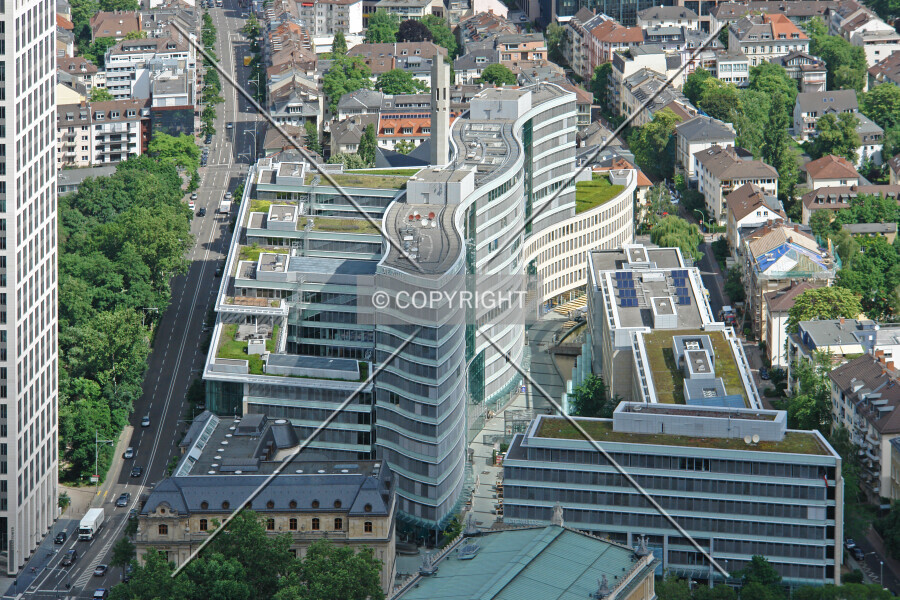
Pictured: Frankfurter Welle
A wave is essentially the curved equivalent of a zig-zag. The plan should conform to a single curved path with at least two round bends in it, alternating the direction at each bend.
There may be angles at the ends or along the edges, but if the general direction of the shape forms sharp angles, then the plan should be called a zig-zag instead of a wave.
The successive reversals of curvature distinguish a wave from an arc, which bends in one direction without reversal. Small angular details can occur at the edges or ends while the main path retains its rounded bends.
wave Photos
Related definitions
-
arc
A building plan following a single open curve without reversing direction or closing into a loop. -
circle
A roughly circular building outline, including regular polygons with nine or more sides and minor perimeter details. -
cross
A building plan formed by two straight members intersecting within 22.5 degrees of a right angle. -
ellipse
An oval or nearly oval building plan, including a rectangle with two curved sides blending into a continuous outline. -
heptagon
A building plan with seven discernible principal sides meeting at convex angles, with unequal sides permitted. -
hexagon
A building plan with six roughly equal principal sides meeting at similar convex angles. -
irregular
A building plan whose overall outline cannot readily be assigned to another defined perimeter form. -
jagged polygon
A building plan with many corners and several perimeter indentations, arranged regularly or irregularly. -
multi-winged
A building plan with at least two wings branching from a spine, excluding wings that all radiate from one point. -
octagon
A building plan with eight roughly equal sides, including sufficiently chamfered squares that appear octagonal. -
open angle
A building plan with two roughly linear segments meeting at one point, or a simple shape with a notch of at least 45 degrees. -
parallelogram
A floor plan with 4 sides in 2 parallel pairs which do not meet in right angles. -
pentagon
A building plan with five principal sides, allowing unequal lengths and minor notches or corner changes. -
radial-lobed
A floor plan in the shape of a flower or star, with radial wings arranged around a common center. -
rectangle
A floor plan with 4 sides meeting at right angles and one axis longer than the other. -
semicircle
A building plan with one main straight edge and one arc, occupying no more than 75% of the corresponding circle or oval. -
square
A four-sided building plan with right-angle corners and side lengths differing by no more than 5% of the shortest side. -
trapezoid
A four-sided building plan with nonparallel sides, distinguished here from square and rectangular plans. -
triangle
A building plan with three dominant straight sides, allowing unequal lengths and slightly rounded or chamfered corners. -
zig-zag
A floor plan with 3 or more sections connected in a line bending in alternating directions.